Showing posts with label 建築の迷戀 (Architecture). Show all posts

Tuesday, February 10, 2009

Her Own Private Idaho

小時候曾夢想自己有這樣的一個家 - 屋內有很多落地玻璃窗,可以看見山又看見海,更可以目睹四季的變化。當陽光滲進屋內便把一室鍍上金黃色。。。也許世上真是有這樣的屋子,但自一出生便受到都市生活的洗禮,單單是想像在四野無人、方圓十里無超市兼要嚴冬踏雪回家的環境下生活,已叫我吃不消。

凡事總有代價。


Jan McFarland Cox, an artist and designer, spent nearly a decade of her life building a house in the Idaho desert, along with architect Tom Kundig.


“This is definitely where the deer and the antelope roam,” Ms. Cox said, looking out a window offering stunning views of the constantly changing scenery of the Pioneer Mountains.


Ms. Cox's collectibles include vases by Christiane Perrochon, a ceramicist in Tuscany.


Ms. Cox is sure there will be days during her first winter in the house when her long driveway is impassable. She said she is prepared to come and go on snowshoes.

All Photos from Stuart Isett for The New York Times

Sunday, March 02, 2008

再織城市‧Refabricating City

香港‧深圳城市/建築雙城雙年展<<再織城市>>

日期:1月10日至3月15日 (星期一休館)
地點:中環荷李活道10號中區警署建築群


拖了這麼久才去看這個,確是太laid back了-___-!

其實,我在它開幕前幾天已探了一次軍情,感覺像劉姥姥進大觀園﹗

這次正式在現場看一次,感覺仍是地方大展品多,有心去的話,要預大約2小時才夠時間看! 又或者如果你像我般,跟它住得不算遠,可考慮分2、3次去,會容易消化些。不過展覽將於本月15日結束,要快喔﹗

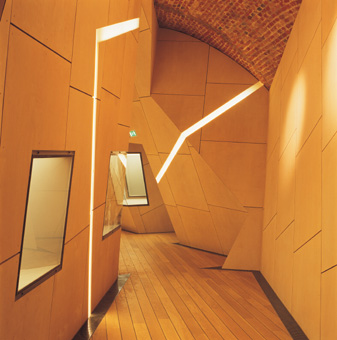
這個雙年展最吸引我的地方是展場,那麼的獨一無二,那麼的趣味盎然,直教人回味香港往昔的種種。那一道一道的長廊,有如時光隧道,引領觀衆回到那個已不復再的年代。。。

只能說是一個時代的終結吧﹗如今唯有寄語馬會將來好好處理這個中央警署建築群Herzog & de Meuron是叫人期待的,但很多香港人如我更期待大家的歷史文化遺產不會白白流失。

舊日文化的痕跡交叠着當今亦中亦西的創作理念,是這個展覽最特別之處。至於展品,很多是與空間和建築有關的繪圖、模型和裝置等等,是讀建築或室內設計的朋友絕不能錯過的,但其他人則未必有很大共鳴,觀衆可考慮多花時間看其他有關藝術或設計的裝置,反正場地本身就是一件最引人入勝的作品。

Friday, June 29, 2007

高雄國家藝術文化中心

文章轉載 --> 競圖及競賽: 高雄國家藝術文化中心國際競圖決選設計讓你看個夠!

像是有意融入環境生態一部分的設計,與藝術間或走出殿堂、「飛入尋常百姓家」的氣魄同樣可敬。

引頸以待呢!

Saturday, June 02, 2007

天堂、地獄、煉獄


(Source: New York Times **do not miss the slide show inside**)

Heaven, Hell and Purgatory
HILVERSUM, the Netherlands
Neutelings Riedijk Architects

電影界有《天堂、地獄、煉獄》三部曲,建築界則有荷蘭這幢The Netherlands Institute for Sound and Vision。玻璃外牆比喻天堂;辦公室代表煉獄;中庭儼如是地獄,很有趣的聯想。不過這三部分以天堂最為引人入勝吧?以電腦科技合成的畫面色彩斑斕,全是荷蘭電視史上最經典的場面,當中包括足球名宿告魯夫的射球。誰說天堂定必沉悶? 天上人間。

不過那些畫面影像模糊,似是凝固於某個時空之中,據說目的是代表共同回憶之餘,亦反思現代社會資訊過盛的問題。真的假不了,假作真時真亦假,但所有是是非非在這一瞬都變得無傷大雅。

Hilversum是荷蘭電視界的集中地,反映這種意識形態,這建築不難成為這城市的地標。

Saturday, April 28, 2007

Louis Kahn

"The Life and Times of Louis I. Kahn 2007"
Presented by Zuni Icosahedron
4.27-29.2007 Kwai Tsing Theatre Auditorium

An iconoclastic interplay of visual images, music, acting, monologue and silence to illustrate the highly lyrical, poetic and philosophical statements of the celebrated architect Louis I. Kahn.

If Kahn had ever tried to sculpt and privatize light in his architectural works, I think Mathias Woo also effectively sculpted Kahn in this highly inspiring play.

* * * * * * * * * *

Kahn's statements on desire, beauty, silence, light and joy:

Desire
The measure of the greatness of a place to live must come from the character of its institutions, sanctioned by their sensitivity to desire for new agreement, not by need, because need comes from what already is. Desire is the thing not made, the roots of the will to live.

Beauty
Of beauty: Not the beautiful, not the very beautiful. Just beauty.

Design is not making beauty; beauty emerges from selection, affinities, integration, love.

Silence
Silence to Light
Light to Silence
The threshold of their crossing
is the Singularity
is Inspiration
(Where the desire to express meets the possible)
is the Sanctuary of Artis the Treasury of the Shadows
(Material casts shadows shadows belong to light)

Light
Light is really the source of all being.

I sense Light as the giver of all presences, and material as spent Light. What is made by Light casts a shadow, and that shadow belongs to Light.

Joy
Joy is the keyword.

* * * * * * * * * *
進念的劇偶爾會看,因為對我來說: 他們可以是糖,也可以是苦茶。(待續)

Tuesday, February 06, 2007

2 Archi-dive

-- originally posted on 29 January 2007 --

在06年12月號的W magazine,有一篇關於Zaha Hadid的報道,把她說成《Devil wears Prada》的Miranda似的,人未到霸氣先到。有主見的她從不輕易就範於任何人的安排,包括她的私人助理及客戶:

「我不會去馬賽、亦不會去巴黎。誰替我約的?」

「誰挑的顏色?多麼可怕!」當私人助理告訴她那是客戶選的,她便會直截了當的說:「嗯他們不可以要怎樣便怎樣!」

嘩真有種!

繼成名作德國消防局(Vitra Fire Station)後,Hadid的作品要多激進就有多激進。儘管毀譽參半,她還是摘下了2004年的Pritzker Architecture Prize,是首位女architect得此殊榮,多威水!

這邊廂在日本建築界,女性建築師要冒出頭來看似也不易。Kazuyo Sejima算是十分威水吧,受注目的作品包括近年成為旅遊熱點的金沢21世紀美術館(21st Century Museum of Contemporary Art, Kanazawa)和日本東京的Christian Dior店。

Hadid與Sejima
一個西、一個東
一個語出驚人、一個靜謐含蓄
一個烈女風範、一個禪味十足
在男性主導的建築界
各自各綻放異彩
不愧是當今建築界兩朵奇花

方圓

-- originally posted on 17 January 2007 --


自少已好喜歡康樂大厦(現稱怡和大厦,但我總改不了口),名字親切感覺又像康樂棋。還有,毎當看到它,雪糕車還會遠嗎? 那是兒時一種簡單的幸福。至今每逢路過我都感到那音樂猶在,真真假假分不清……

高聳入雲的康樂大厦四平八穏,簡約外形無疑現代味十足,卻有着古典主義對幾何學的擁戴。那不斷重複的圓形窗口,像Bach的音樂,工整卻不呆板,很spiritual。尤其在晚上,像變魔法似的,異色散落在每一個洞,目不暇給。

方方圓圓的它永不愁寂寞,親朋戚友遍佈世界各地。


The COR Building by Chad Oppenheim @Miami
(to be realized)

Photo credit: Inhabitat


Tomihiro Art Museum (富弘美術館)
by Toyo Ito

Photo credit: yufulin


Yatsushiro Municipal Museum (八代市立博物館)
by Toyo Ito

Photo credit: colbwt


Hotel Maritime @New York

Photo credit: www.nyc-architecture.com


My washing machine ^.^

永恆

-- originally posted on 8 December 2006 --


永恆是我們那浮動的價值觀與理解所投射出來的意象。

永恆不是一個既定的國度,也不是一個目的地。

永恆是人生旅程上某些重要的驛站。那是終結,亦是起點。

永恆像精彩的旅店,很想住進,卻總在Check in 前錯過。

剎那若永恆,它們就住在毗鄰。

看見了Louis Kahn 的建築,剎那間,像住進永恆。

Monday, February 05, 2007

In Praise of Slowness

-- originally posted on 8 December 2006 --


Heard about Carl Honoré's《In Praise of Slow》many many times. A shame that I have not read it yet but sooner or later I surely will. Just the title itself is tempting enough to me, for I am also a somewhat "slow" person and always think that speed is not necessarily a solution to all problems while slowness itself is no sins. In many ways I celebrate slowness. Being slow is to put on brakes. Our modern life is too preoccupied with speed in many aspects – technology, work, food, sports and pathetically, relationships. The phenomenal "live fast, die young" school was once a heroic equivalent of "carpe diem". However, it now seems so ridiculously obsolete in the 21st century. The art of living slowly and gracefully is, in fact, full of wisdom.

Before I can share anything more about this book, I suddenly remember that ages ago I bumped into another book about the art of being "slow". In coincidence, I was asked to write something on it while taking an architecture course. Surprisingly, there is an intriguing relationship between writing and spatial manipulation.

Milan Kundera

Milan Kundera was born in 1929 in Czechoslovakia and since 1975 has been living in France. He is incontestably a brilliant and intriguing writer who stuns his reader from time to time by his miraculous metaphors and fresh perspectives. Ages ago I was utterly captivated by his most acclaimed piece 《The Unbearable Lightness of Being》. I know I am not alone here, for I once heard about how young readers spent weeks and weeks discussing the book with their intellectual friends. 《Slowness》 represents my third encounter with his magic realism.

Slowness

《Slowness》is about speed and place, or more broadly, about time and space, the dimensions of our existence. It delineates three episodes of different time, space, and people. The first one is the narrator's account of his travel, the second is about Vivant Denon's novella 《Point de Lendemain》, and the last one concerns Vincent's adventure at the entomologists conference. Each of them stands on its own but altogether they intertwine to illustrate contrast and parody. This is particularly so in terms of the last two episodes. They are both seductive and erotic in nature but they ultimately reach different canons of tastes and aesthetics. The episode in the novella is viewed as a construction of delicacy and sophistication, while the episode at the conference is exposed in much vulgarity. Kundera shows us those who can understand and master the art of speed are going to lead a better life in their contemporary world.

《Slowness》is nostalgic, as the refined quality in eighteenth century is glorified, while the flux induced by modernity is critiqued. One of the critiques of modernity is that people today tend to celebrate speed at the expense of wholeness. As Conrad says, modernity is about the acceleration of time, and also the dispersal of places (Modern Times, Modern Places : 1998). Slowness allows us to generate or prolong pleasure, as evident in Madame de T.'s memorable night with the Chevalier, or Pontevin's joke on the female typist. On the other hand, speed detaches us from time and space, and even from our own body and flesh into a state of ecstasy, as the example of speed driving has shown us. Continuity in time is forgone in exchange for ecstasy, which is also the major critique presented in 《Slowness》.

Novel as Architecture

If novel or story telling is similar to architecture in some ways, then the most prominent part will be their shared importance of continuity as achieved by smooth transition in the course of space penetration. Without a smooth transition at meaningful intervals, it is like a person being detached from his own time and place, body and flesh, thus falls into a labyrinth. This situation is analogous to the legacy that the industrial and technological revolutions have bequeathed upon modern people like us. It's shaken up our normal perception of space. We may henceforth enter from one space to another, without going through a physically or psychologically noticeable transition. That brings us a sense of loss in space and time plus a feeling of ecstasy.

As such, ecstasy is celebrated at the expense of pleasures, which, according to Epicurus, should be prudent and modest. Subsequently, people fail to appreciate the art of pleasure, but indulge themselves on ecstasy:

The man hunched over his motorcycle can focus only on the present instant of his flight; he is caught in a fragment of time cut off from both the past and the future; he is wrenched from the continuity of time; he is outside time; he is in a state of ecstasy. (pp. 3)

Therefore, the art of novel is like the art of architecture, that is to say, both of them require a skilful designer to lead us all the way through with good transitional intervals. Certain parts need to be speeded up, while certain parts needed to be slowed down. Then one will remember that book or building because one's pleasure is derived from the experience of looking with the right pace at the right time. Abruptness may cause excitement or ecstasy, but no lasting memory. That's why Kundera drew up his formula in the following way:

In existential mathematics, that experience takes the form of two basic equations; the degree of slowness is directly proportional to the intensity of memory; the degree of speed is directly proportional to the intensity of forgetting. (pp. 34-5)

While Madame de T. is a marvelous architect, so are Pontevin and Kundera himself. Their respective patrons, the Chevalier, both of Pontevin's visible and invisible audience, and Kundera's readers, are all going to marvel at those masterpieces and be moved by the remarkable space that they have been led through. Madame de T. knows when to slow down and how to construct meaningful intervals that logically and smoothly leads to another stage. As Kundera depicted, she shaped her night “like a triptych, a night as an excursion into three stages: first, they walk in the park; next, they make love in a pavilion; last they continue the lovemaking in a secret chamber of the château.” That requires substantial sophistication, for she maps out her "immediate" and "more distant" future with exquisite rhythm, thus makes the memory of her night with the Chevalier eternal, although the night is ephemeral per se. Prolongation, as opposed to acceleration, of time is celebrated there. Pontevin knows how to manipulate the speed of a speech, for a well-delivered speech will be impressive for his audience. The same joke told by Vincent bears a different outcome because of the inability to manipulate speed and intervals. In this scenario, Kundera shows us an interesting way to conceive conversation:

Conversation is not a pastime; on the contrary, conversation is what organizes time, governs it, and imposes its own laws, which must be respected. (pp. 28)

Writer as Architect

Similarly, a writer has to be able to create suspense at certain stages with successful intervals. Kundera in this case skilfully knits together two episodes, namely Madame de T.'s adventure and Vincent's, that shed light upon the whole question of the art of living. Those two episode are different in time and space, but they share the same important lesson nonetheless, namely one's ability to manipulate speed and to create smooth transition.

Therefore, those who understand the correlation between speed and life live a better life. As such, the book is very existential in nature, a fact that has already been exemplified by Kundera's two equations of existential mathematics. If, as Vincent has pointed out, we cannot prevent ourselves from being dancers in certain ways, so long as we live in our modern world, then perhaps a better way to live will be to dance beautifully. If we cannot avoid speed in an ever-changing world, then we have to manipulate speed, organize time, construct intervals and smooth down transitions so that there will still be room for us to slow down, take a breath, and seek pleasure in Epicurus's terms. Similar philosophy applies to architecture. If an architect cannot resist the flux due to technology, one should make use of it, keep the essence of the good old principles, and make innovations which are unattainable in the past, so as to open up new aesthetic possibilities in space.

Friday, November 17, 2006

The LEGO Land

上回忘了提及「黑鑽」背後原來有間小小的猶太博物館,出自當紅建築師Daniel Libeskind的手筆。

好像香港城大的創意媒體學院也找來他設計校園,確實拭目以待!

Daniel Libeskind, The Jewish Museum
The Royal Library Garden
(Photo credit: Jens Lindhe)
* * * * * * * * * * * *

一直心儀北歐的獨特氣質,尤其是那簡約設計,線條流暢之餘卻不失方便實用,完全演繹了"less is more"的精神。

除了設計,這種迷戀可能是源自早年所看的北歐電影如Ingmar Bergman的"Fanny & Alexander"或Aki Kaurismäki那連對白都省着用的影片。

不過更有可能是因為兒時父親不知從那裏找來給我的LEGO玩具。

總相信,丹麥人的建築智慧一定與LEGO有關。

Henning Larsen, IT University of Copenhagen
(Photo credit: Copenhagen X)
Nordlyset
Tietgenkollegiet

Thursday, November 16, 2006

Black Diamond

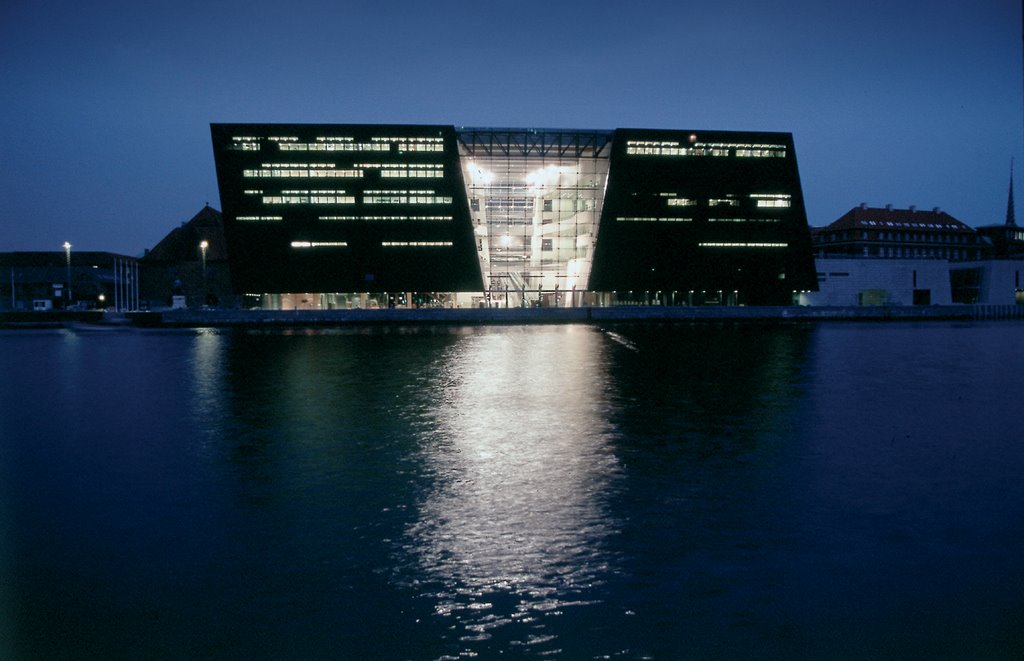
The biggest diamond ever found in the world. Also the most "accessible" diamond that need no extra surveillance to keep it away from theft. It's of zero degree of portability :)

Black Diamond safekeeps a lot of treasures (both literature and art) inside nonetheless. It is meant for all rather than just rich ladies. This gem glows in amazing charm along the river bank of Sydhavnen.

Architect: Schmidt Hammer Lassen
The Royal Library (alias Black Diamond)
Copenhagen, Denmark
(Photo credit: The Royal Library)

Tuesday, November 14, 2006

A Big Fish from HK

I did mention Frank Gehry a few times in this blog. Friends have a gut feeling that he must be my most admired architect. Well not exactly. . . sorry hee :)

But there is really an aspect of his creative career that I admire. Boldness? Uncomprising attitude or aggressiveness? Not really certain but sort of close when seeing his masterpieces such as the titanic-like Guggenheim Bilbao. Uncontestably it is a stunning piece on one hand and a highly contextual piece on the other hand. Its form reminds people of the ship-building root of the Bilbao city. Either because of this or the numerous materpieces housed inside it, it has succeeded in creating a cultural mecca or else a modern myth that constantly draws visitors to this once lesser known Spanish city.

Last Friday night, I finally had the chance to listen to someone from the office of Gehry Partners. Edwin Chan, who worked with Gehry on many terrific projects like the Guggenheim Bilbao, the Weisman Museum, the Corcoran etc., has a Hong Kong origin indeed. One of the reasons for his early departure from HK at the age of 13 or so, according to him, is the absence of any museum or cultural institution alike in HK at that time. A lack of inspiration here nurtured another big fish elsewhere. A living example of "limitations create motivations". Hong Kong, you are the best of places, you are the worst of places.

A most touching remark from Edwin: from time to time he'll go back to Guggenheim Bilbao as though the museum itself were a good old friend or a family member of his.

Today many artists don't even bother to take another glance of their work right after (or even earlier than) its launch. No comment here.

You can still be great if you got a talent. But if you got a talent and a big heart, your artwork will certain glow from within. That's what I believe when seeing Edwin show his final slide with himself smiling in front of the museum giant in the golden glow of sunlight. That's a precise statement of a man's allegiance to his own passion.

Friends we really have to love the arts we create or help to create. Artworks gonna cry if their creators abandon them in a split second.

Tuesday, October 24, 2006

Small Fish·Big Heart

Frank Gehry was named as one of the America's Best Leaders.

Ironically, as an architecture student at the University of Southern California, he was once told to quit.

Well...never underestimate the big heart of a small fish, for he will turn into a big fish one day :)

Wednesday, October 04, 2006

Function Kicks Form's Ass

當一頭栽進建築這個既陌生又波詭雲譎的知識領域後,感覺載浮載沉。所以Chad Smith於Tropolism發表的都市札記無疑是給我持續進修的好機會。看罷他於《Everything Emptying Into White》一文寫有關Paul Rudolph的家,心中又是一陣騷動。

以往誤打誤撞唸了一點建築美學與歷史,現已忘掉內容90%,惟經典金句"Form follows function",卻上心頭。句中形態(form)一詞看似是subject,實則功能(function)才是主角。時移勢易,拜Chad Smith賜教,今天的punch line己換成"Function kicks form's ass" (~呵呵~)。這下可連文法上也function first。


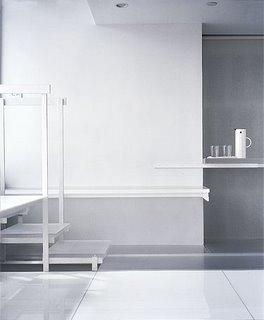
誠然,名建築師的家往往是最佳的作品示範,家居設計猶如芸芸傑作之縮影,盡現當事人對空間使用的獨門秘方,亦貫徹設計者深藏的理念。Paul Rudolph採用簡約至極的白,並採用開放式設計,拆掉界線與邊緣,使空間線條虛實交錯,亦力證現代設計看重multi-function與處理空間的靈活性。

然則功能便很易凌駕於形態,後者的「結局」全然取決於前者所能發揮的極限。這又好像將形態暗降為副車,狠狠將建築與美感脫鉤。

不過世事亦未可料。換個角度看,我們何不將功能看成帶領形態舞動的引子,釋放後者變幻的能量,讓其自由流動?以「有限」換「無限」,何嘗不是美麗的魔法?

一切皆取決於功能與形態的朝夕長短或是相輔相成。


** Thanks to Chad, we know that there is a lovely slideshow showing the renovated house Paul Rudolph did for himself on Beekman Place (courtesy New York Magazine) **

Thursday, September 14, 2006

Zaha Hadid@Singapore


(Thanks Connie for your photos)

對不起,恕我膚淺,着見Zaha Hadid為Singapore Art Museum (SAM) 今年《All the Best》展覽而度身訂造的建築設計,感覺有點像「導彈襲地球」。 >..<

請先別柴台。 敢作敢為的人,向來不會刻意做討好世人的事,唱一學便會的歌,拍一看便知結局的戲。像以前有位叫達利(Salvatore Dalí)的超現實派藝術家,作風狂放敢言,作品奇詭怪異,充滿「不驚人、勢不休」的膽色,絕不似印象畫派那般深受大眾愛載。

但如果世上少了達利,觀眾會很寂寞。所以,我們也不能少了Hadid。

* * * * * * * * * * * *

Like it or not, it's often so spontaneous. No hesitation at all, as though it was a matter of fact. The middle path for appreciating Zaha Hadid is amazingly narrow.

Too deconstructionist to land firmly on the ground? Too organic to integrate itself in the neighborhood? In Hadid's universe, problems seem like challenges and challenges become inspirations. Most probably so, I guess. She's the modern female Don Quixote who keeps realizing the seemingly impossible.

Rien n'est Impossible? Impossible is Nothing? Hadid achieved both.

Wednesday, August 23, 2006

Big Fish


There is often something very "fishy" about Frank O. Gehry, who won the 1989 Pritzker Architecture Prize, the Oscar equivalent in Film. An architect in his own right, he was sometimes more like a sculptor. And now he is even marching bolding into the rivaling sand of "design". That is my first impression when I have recently bumped into his latest design for Tiffany, which is reminiscent of his most celebrated motif - fish.

A devout believer of "architecture is art", Gehry openly admitted that artists like Brancusi had a more profound influence on his work than most architects. Perhaps that explains why most people find his architecture like a modernist sculpture. (By the way, I am completely thrilled by the fact that he also likes Alvar Aalto from the architecture world, for I am a big fan of this Finnish architect.) Gehry made a lot of “fish” in art as in architecture. Fish Dance (Kobe, Japan) is a prominent outdoor sculpture that by far overshadows the restaurant building itself.


Gehry's big fish is, on the other hand, functional in a most intriguing and ecstatic way. Take Barcelona Fish (Spain) for example. As a sculpture, his fish is too massive while as an architectural piece, it is too "fishy". I just wonder how he can accommodate the organic form to the geometric rules in the orthodox canon of architecture. No doubt that modern architects are rule-breakers, as much as the modern icon of the avant-garde in art. Loads of architects like Gehry and Zaha Hadid moved away from norms. They tested upon the limits of violating geometry.

As Gehry states, "I approach each building as a sculptural object, a spatial container, a space with light and air, a response to context and appropriateness of feeling and spirit. To this container, this sculpture, the user brings his baggage, his program, and interacts with it to accommodate his needs. If he can't do that, I've failed."

Recently, Gehry has been shifting from big to smaller fish. From Barcelona Fish and Fish Dance to his Fish Lamps, Pito Kettle for Alessi and Tiffany jewelries, I am not sure what's in the mind of this big big fish ;-)